My Works
SneakySwing Coach Experience
The brief was AI verification. Coaches on the platform didn't need it. What they needed was something much simpler — and finding that changed everything built after.
Role
Product Designer
Period
Apr — May 2026 · 6 wks
Tools
Figma · Cursor
Impact
Roadmap redirected before dev started
The Problem
Most coaches opened a task. None of them touched annotation.
THE BRIEF
Design an AI verification and lesson planning flow. Coaches would review the AI-generated diagnostic report, validate or override findings, prioritize issues, and build a training roadmap. The assumption: AI analysis was the core value-add that made the coach side worth using.
WHAT I FOUND
The data told one story. Coach interviews told another.
Product analytics showed that most coaches who opened a student task never touched the feedback tool. But the more important finding came from research: experienced coaches don't need AI to tell them what's wrong with a swing. They watch the video and can assess it themselves. Every coach said the same thing unprompted. The AI diagnostic report — the thing the entire brief was built around — was overhead before the actual work could start.
The original brief had the order of operations wrong. The app was asking coaches to verify AI findings before giving them the tool they reach for in every session.
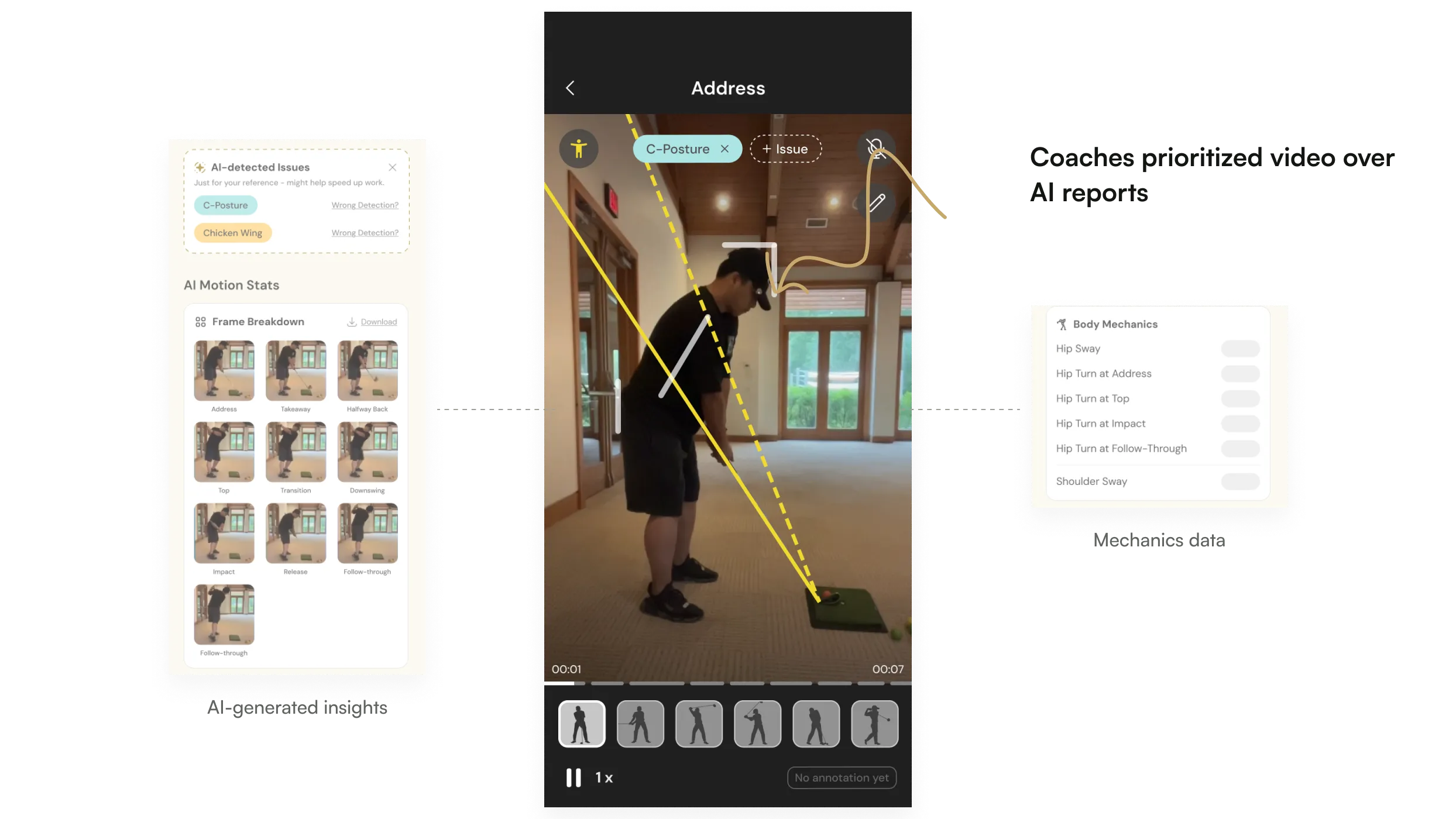
The AI had already flagged C-Posture. Coaches still led with what they saw.
The Decision
Ship the tool coaches already reach for. Reposition AI where it actually helps.
The to-be flow — student management, AI-assisted feedback, prescription and lesson planning — was the right long-term architecture. It wasn't the right first thing to build.
Coaches were already using third-party apps (V1, OnForm) that screen-record the annotation process: scrub to the right frame, pause, draw in sequence, talk through it. That's how coaches teach. SneakySwing's existing tool sent students a single annotated snapshot and a voice note. The coaching process itself didn't make it through.
Building with screen recording — so the clip captures what the coach actually does, not just where they ended up — was the one change that made the output useful.
AI didn't get removed. It got repositioned. Inside the annotation flow, AI generates a text summary of the coach's voice recording for review and edit before sending. That's AI at the right stage: assisting the coach's process, not replacing their judgment.
The Impact
The most significant outcome is what didn't get built.
2 findings
User research findings that reversed the roadmap before a single line of code shipped
1 prototype
Led to one roadmap redirect, before dev started
0
Lines of the wrong feature shipped
The original plan was to build an AI verification flow before validating whether coaches would use it. Building and testing a prototype first surfaced the answer before a single line of production code went in the wrong direction. Development began in late May 2026 — pointed at the annotation feature coaches actually reach for.
Reflection
Sequencing is strategy.
The AI features in this product aren't wrong. They're not the right starting point. Experienced coaches have years of diagnostic judgment built in — for them, AI analysis is redundant. For students and newer coaches, it's exactly the right tool. The interesting design question isn't whether to include AI. It's when. Get the sequence wrong and AI feels like a gatekeeper. Get it right and it feels like an assistant. That's the difference between a feature coaches avoid and one they trust.